
The alarm goes off, you sit up and your body responds with a delay. A stiff neck, a rigid back, loaded shoulders. You’ve spent seven or eight hours in bed and still get up as if you’d been moving furniture. Very often the explanation lies in three things we hardly ever check: your sleeping position, your pillow and your mattress.
The essentials in 30 seconds
- There’s no single best sleeping position: the right one keeps your head, neck and back aligned and lets you rest.
- Your pillow should fill the gap between your head and the mattress: higher if you sleep on your side, lower on your back, almost flat on your front.
- A review of 39 studies links medium-firm mattresses with more comfort and better sleep quality.
- Habits count as much as materials: regular hours, a dark, cool bedroom and no screens in the last hour.
What’s the best sleeping position?
The best sleeping position is the one that keeps your head, neck and back in a comfortable line and lets you rest all night. For most adults that means on your side or on your back, with a suitable pillow. Sleeping on your front forces your neck to stay turned for hours.
Good news: you don’t have to sleep “perfectly”. Nobody spends the night motionless. A Norwegian study that used sensors to measure adults’ sleeping positions recorded an average of 1.6 position changes per hour. Moving in bed is normal and a good thing.
The same study found that adults spend around 54% of their time in bed on their side, 38% on their back and only 7% on their front. And that side sleeping becomes more common with age: between 55 and 65 it reached 58% of the time.
The idea isn’t to force yourself into one position, but to make sure the one you start the night in is comfortable for your body.
Is it better to sleep on your side, back or front?
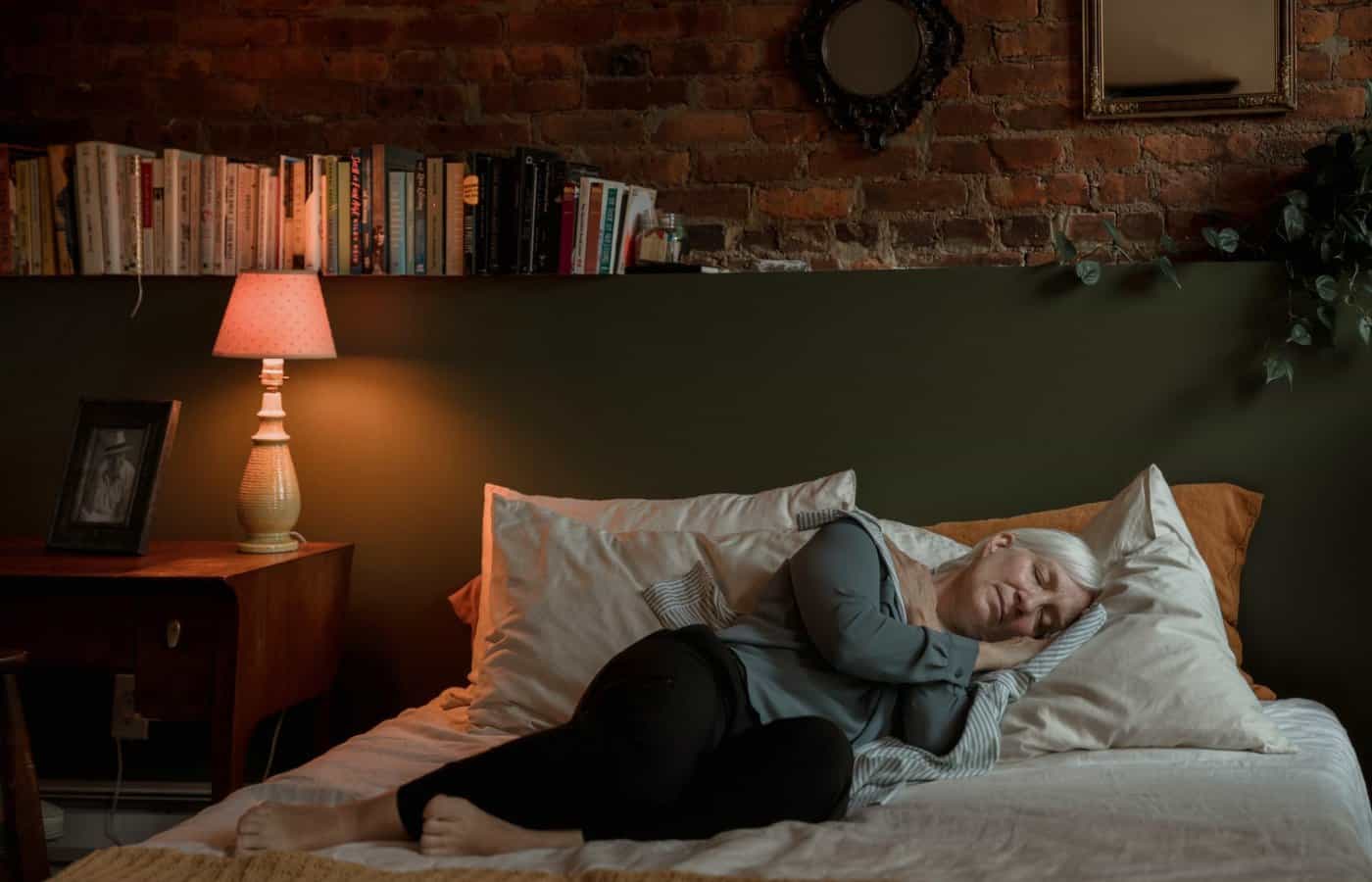
Side and back sleeping are the kindest options for your neck and back if your pillow is right. Front sleeping is the most demanding: your head stays turned for hours and your lower back tends to arch. If it’s always been your position, you can adapt it with a few small changes.
| Position | Pros | Watch out for | Simple fix |
|---|---|---|---|
| On your side | The most common in adults; comfortable for many people | Squashed shoulder, neck dropping if the pillow is too low, top knee “pulling” on the hip | A pillow that fills the gap at your shoulder and another between your knees |
| On your back | Spreads your weight well; head and neck in line | A high pillow pushing your chin towards your chest; tense lower back | A lower pillow and a cushion under your knees |
| On your front | Some people fall asleep faster this way | Neck turned for hours; arched back | A very flat pillow or none at all, and a thin cushion under your pelvis |
- 01The most commonOn your sideA pillow that fills the gap at your shoulder and a cushion between your knees
- 02Low pillowOn your backA lower pillow and a cushion under your knees
- 03With careOn your frontA very flat pillow: the most demanding for your neck

- Your neck spends hours turned to one side so you can breathe
- One bent leg rotates your pelvis
- Shoulders and hips aren’t on the same plane: your spine sleeps twisted
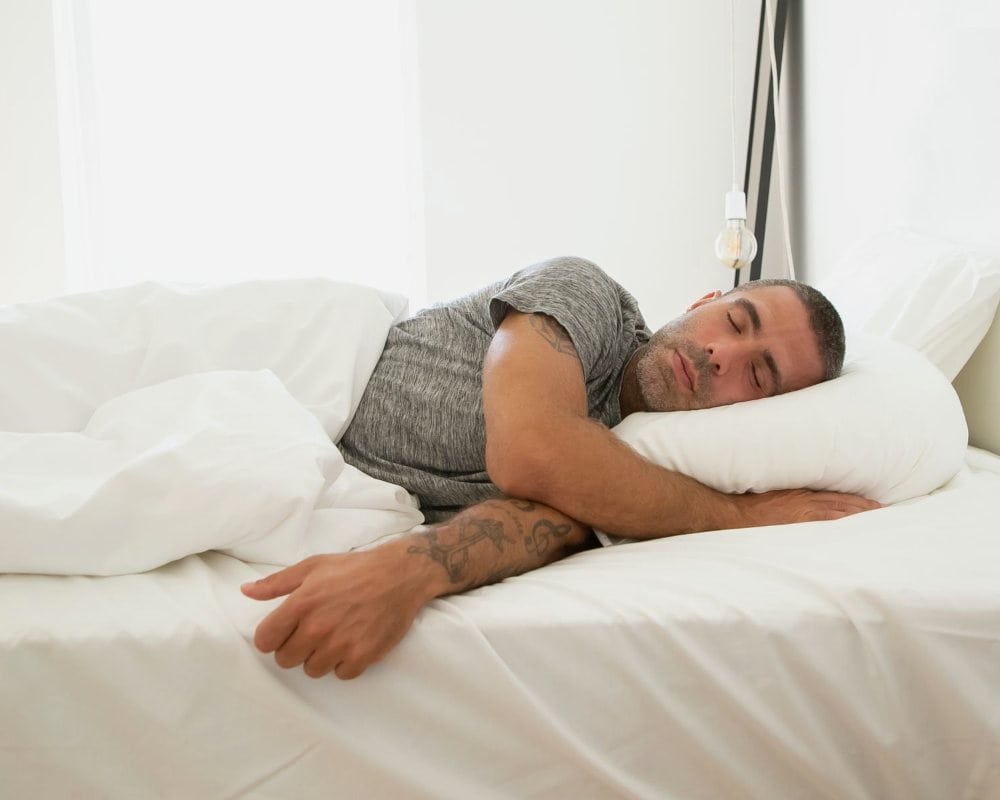
- Head, neck and back in one line
- A pillow that fills the gap up to your shoulder
- Arm in front of your body, not squashed underneath

- Neutral neck, not turned
- A low pillow that doesn’t push your head forwards
If you always wake up with a stiff neck on the same side, notice which way you turn your head as you sleep. Sometimes simply swapping sides of the bed or placing your pillow differently is enough.
Which pillow is best for the position you sleep in?
The best pillow is the one that fills exactly the space between your head and the mattress so your neck stays in line with your back. On your side you need more height, roughly the distance from your neck to the edge of your shoulder. On your back, less. On your front, almost none.
The material (memory foam, latex, fibre, feathers) matters less than height and firmness. A pillow that’s too high pushes your head forwards; one that’s too low lets it drop. Either way, your neck spends the night working.
How to check your pillow in one minute
- Lie down in your usual position and ask someone to look at you from the front (if you sleep on your back) or from behind (if you sleep on your side).
- Your nose, chin and the centre of your chest should form a roughly straight line.
- If your head tilts towards the ceiling, the pillow is too high. If it drops towards the mattress, it’s too low.
- Fold the pillow in your hands: if it doesn’t spring back into shape, it has reached the end of its life.
The cushions hardly anyone uses (and you should try)
- Between your knees, if you sleep on your side: stops your top leg rotating your hip and lower back.
- Under your knees, if you sleep on your back: softens the arch of your lower back.
- Hugging a cushion on your side: stops your top shoulder falling forwards and your chest closing in.
How can you tell if your mattress is right for you?
A good mattress supports your body without sagging and gives enough at the shoulders and hips for your back to stay aligned. A review of 39 studies linked medium-firm mattresses with more comfort and better sleep quality than very soft or very hard ones.
“The harder the better” is still a widespread belief, but it isn’t what that 2021 review points to. Its authors acknowledge that studies don’t always agree: your personal preference still counts for a lot.
Signs your mattress is ready for retirement
- It has a visible dip where you sleep.
- You wake up stiffer at home than when you sleep elsewhere.
- You can feel the springs, or you “roll” towards the middle or towards your partner.
- You toss and turn looking for a comfortable position before falling asleep.
If you sleep on your side, a mattress that lets your shoulder and hip sink in a little is usually more comfortable. If you sleep on your back or front, a slightly firmer one stops your pelvis sinking. When you go shopping, lie down for at least a few minutes in your usual position, with your own pillow if you can.
Why do you wake up stiff even after a full night’s sleep?
Because morning stiffness depends on many things besides your bed: how still you are during the day, built-up tension, irregular hours and poor-quality rest. Checking your position, pillow and mattress helps, but your daytime habits and that last hour before bed count as much as the materials.
It’s not unusual. According to figures published in 2024, 48% of adults in Spain don’t get good-quality sleep. And the US CDC recommends 7 hours or more for adults aged 18 to 60, 7 to 9 hours from 61 to 64, and 7 to 8 hours from 65 onwards.
The NHS sums up the basics in a few simple tips:
- Go to bed and get up at similar times, weekends included.
- A quiet, dark and cool bedroom.
- Avoid your phone, tablet and computer in the hour before bed.
- Go easy on caffeine in the afternoon and alcohol before bed.
- A calm wind-down routine: reading, slow breathing, soft music.
And one piece we tend to forget: how you’ve spent your day. If you’ve been sitting for ten hours, your body arrives in bed already loaded. Micro-breaks at the computer are an investment in your night too.
A 3-minute routine before bed to let go of tension
Three gentle movements for healthy adults, done on the bed. No forcing. If any of them doesn’t feel comfortable, skip it.
1. Knees to chest
Lying on your back, bring both knees towards your chest and hold them with your hands. Rock very gently from side to side, letting your lower back settle into the mattress.
Dose: 5 slow breaths · every night
2. Gentle lying twist
On your back, knees bent and feet flat. Let both knees drop to one side while you turn your head the other way. Come back to the centre and switch sides.
Dose: 6 slow twists, alternating sides · every night
3. 4-6 breathing
With one hand on your belly, breathe in through your nose for a count of 4 and out through your mouth for a count of 6. Notice your shoulders moving away from your ears with every out-breath.
Dose: 6 breaths · already in your sleeping position
If you still wake up stiff, also try our 5-minute routine to start the day feeling loose. And if you’d like to know how your body moves, at our centre in Malgrat de Mar, in the Maresme, and at our Barcelona centre we assess your mobility, strength, balance and posture, and give you tips for your daily life and your rest.
Important: this article offers general information about wellbeing and healthy habits. Chiropractic at Ôlin is wellness-focused and does not replace medical care. If you notice any symptom that worries you, please see your doctor.
Frequently asked questions
Is it bad to sleep without a pillow?
It depends on your position. If you sleep on your front, a very flat pillow or none at all may feel more comfortable. On your side or back, without a pillow your neck usually drops and it’s easy to wake up with a stiff neck.
How often should you replace your pillow?
Rather than counting years, look at its condition: if it has gone flat, is lumpy or doesn’t spring back when folded, it’s time for a new one. Fibre pillows tend to lose their shape sooner than latex or memory foam ones.
Which side is better to sleep on, left or right?
For your posture, what matters is that your pillow fills the gap at your shoulder and that you have a cushion between your knees. Switching sides from time to time helps avoid always loading the same shoulder.
Which pillow is best for a stiff neck?
The one that keeps your neck in line with your back in your usual position. Rather than a specific model, look for the right height: high and firm if you sleep on your side, medium or low if you sleep on your back.
Can you change your sleeping position?
Yes, although it takes a few weeks. Start the night in the new position with your cushions well placed; if you wake up in the old one, simply settle back. Moving during the night is perfectly fine.
Want to wake up feeling looser?
First visit: €80. It includes a conversation about your habits and your rest, a complete assessment and a first chiropractic session, with no commitment. In Barcelona (Eixample) and Malgrat de Mar.
Sources
- Skarpsno ES et al. — Sleep positions and nocturnal body movements based on free-living accelerometer recordings, Nature and Science of Sleep (2017)
- Caggiari G et al. — A literature review on mattress type and sleep quality, Journal of Orthopaedics and Traumatology (2021)
- Redacción Médica — 48% of adults in Spain don’t get good-quality sleep (2024, in Spanish)
- CDC (United States) — About Sleep (2024)
- NHS, Every Mind Matters — Fall asleep faster and sleep better